cultural euphoria
There is a pleasure that is hard to put into words in the experience of "falling in friendship" founded in Korean language.
I went into the eastern mountains this past weekend with a co-worker-friend who I didn't know very well but wanted to. We had invited others, but only the two of us ended up signing up for an overnight snowboarding camp. We met at 6:40 AM on Friday morning and took a two-hour bus ride to Pyeongchang. When we arrived, we had another few hours before the start of the program so we sat in a food court and chatted the entire time.
We spoke in Korean, in the formal tense. And though we are the same age, we called each other Aerie-teacher and JM-teacher as you would in a Korean work setting. Every so often I would ask her the meaning of a word and she would patiently explain it to me.
Learning a new skill completely from zero is humbling. It was my first go at something new since I started drum lessons last year. Unlike drumming, I got the hang of snowboarding after a day of lessons. It took me a while to fully understand the instruction to "put tension in your calves!" but after I felt the sensation once, I had it. We didn't get to learn how to snowboard backwards, but I could zig zag down the penguin hill like a pendulum.
The second day of camp was a free day, and JM and I alternated between coffee, going up and down the penguin hill, and eating in the cafeteria. When we got home, an accommodation provided to us, we were exhausted from trudging through the snow. I settled into the couch. I had been itching to finish the final third of my book. JM brought a comforter to me. After nearly an hour, during which JM took a shower and then lay quietly on the heated floor in her own comforter-nest near the socket in the wall where our phones were charging, I hugged the book to my chest and let out a whewwwww. It was so good. So good so good so good, I kept saying. JM took a photo of me like that.
I then took a shower too, where I thought about a particular passage:
"Listen, Case." He's never called me that until halfway through dinner tonight when he started copying Caleb. He steps us out of the window light, not wanting to be seen anymore. "I know you're scared. It's scary. But I love you and we are good together. I feel so good when I'm with you. God, I like myself when I'm with you."
"I'm not sure that's being in love with me, Oscar. That's being in love with you."
I had had a similar experience with an older man, like Oscar is to Casey in "Writers & Lovers." On our fifth date, I felt strangely inarticulate. Maybe it was the soju, but I couldn't really focus on what he was saying—nearly ranting, actually, and I mostly listened and nodded along. It was a politically flavored topic on which I would normally have a lot of opinions. But that night I thought: this isn't going well and I am uncomfortable. Anyway, that is the night he chose to tell me he was in love with me. (We didn't last).
JM and I moved ourselves to the kitchen table. She asked me why I liked the book so much. I asked her if she had ever known Big Love. She said yes. She dated a man who knew the name of every plant. When they walked outside, he would turn his head toward the scent of a flowering tree and tell her what it was called. Her voice rose when she talked about him. She spoke more quickly, more fluidly. After two days in each other's orbit, she transitioned fully into the casual tense. I noticed the switch immediately and tried to contain my thrill. You know when a friend who isn't very physically affectionate gives you an unexpected hug? It was like that—I relished the way JM enclosed us in more intimate language.
I have an older male friend who I've been running with since I moved here seven years ago. We've been clubbing into the morning together, sharing a cab back home because we live in the same neighborhood. We've shared countless meals, gone to the theater, just the two of us. All the while, he spoke to me in Korean in the polite tense, despite a handful of heavy hints I've strewn along the way that I'd like him to drop the formality. I wanted him to acknowledge me, linguistically, as his dongseng, his little sister. The day he finally did—about two months ago—was a special occasion. An occasion of cultural euphoria, when my desire for acceptance, to be claimed and called in, gets granted.
I'm borrowing from the phrase "gender euphoria" with respect, knowing that I have, for most of my life, experienced alignment between my gender identity/expression and gendered experience. But while living in Korea for the past seven years, there have been moments when my foreignness has posed a barrier to native connection.
As a gyopo—literally in Chinese characters: gyo (overseas) po (womb)—meaning, overseas but of the same womb, or simply: a person of the Korean diaspora, these moments of inclusion, however minor, can be identity-affirming. I feel Korean euphoria when the woman who runs the banchan store near my house asks me why I haven't been around while stuffing free sides into my tote bag. I feel euphoric when the owner of the bathhouse in my neighborhood asks me, aren't you the sister who ran here last time? I felt it again, sitting across a kitchen table from JM as she told me about the man she once loved.
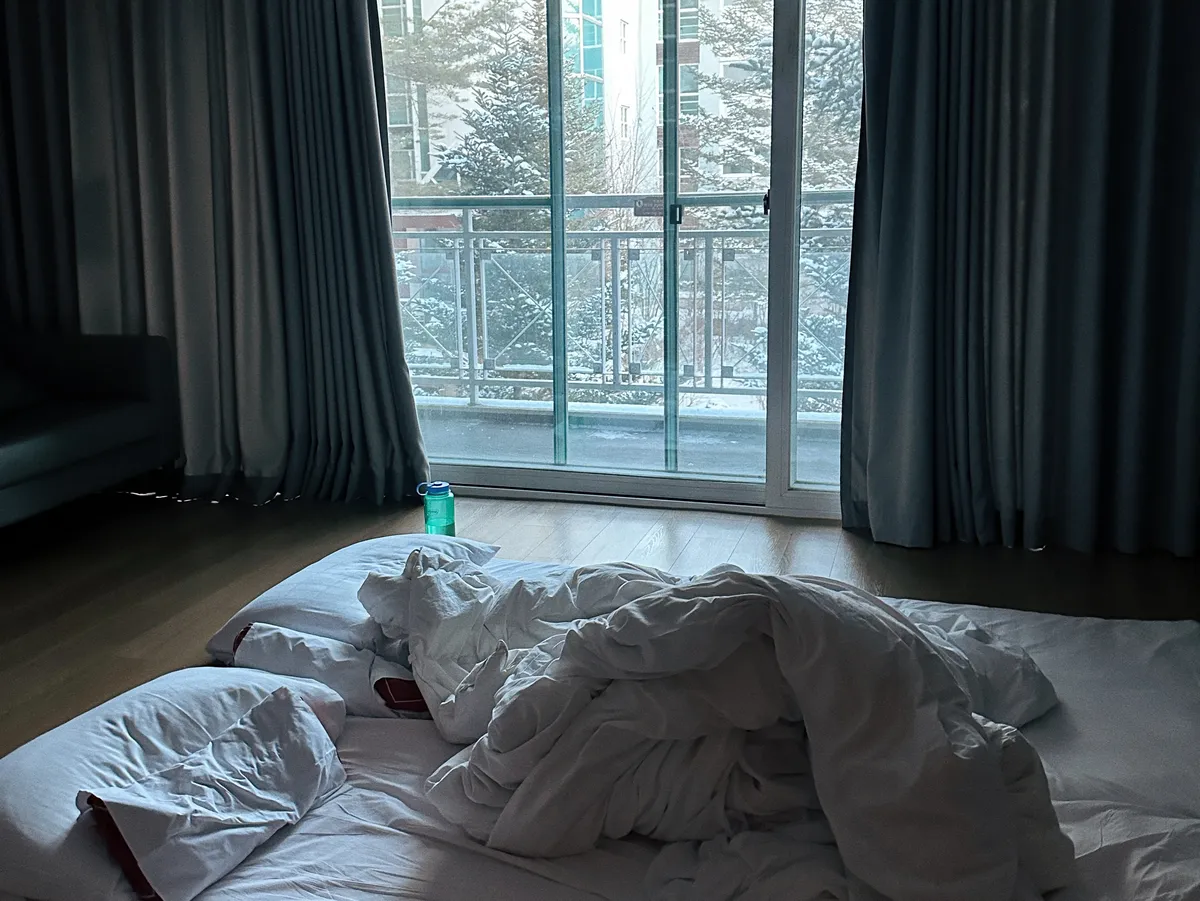
That night, although our accommodation had two bedrooms, we found extra bedding in the closet and decided to sleep side-by-side on the floor in the middle of the living room. When we woke up the next morning and pulled apart the floor-to-ceiling curtains, the trees were covered in snow.